Showing posts with label web. Show all posts

Tuesday, April 03, 2007

GeoURL (2.0)

GeoURL (2.0)
Tell the world about your web site in terms of where you are located. Beautiful map showing registered web sites:

Friday, January 05, 2007

Lifehacker


This is a very useful blog where the author gives little recipes for doing things on / for / using your computer and the Internet. This is is Tips & Tricks or How do you do ... type of site. Here is an excerpt from a Wall Street Journal article about Lifehacker and Ms. Trapani:

Gina Trapani is always looking for a clever shortcut -- from a better way to organize her email inbox to keeping track of her Web passwords. So, it seems, are plenty of other computer users.

Ms. Trapani, 31 years old, is the editor of the Lifehacker technology blog, which dispenses do-it-yourself advice and time-saving computing tips. Traffic to the site, one of several blogs published by Gawker Media, has surged since its launch two years ago as it has become a must-read for many computer novices and geeks alike.

"She focuses on information that'll make her readers' lives more productive," said Robert Scoble, author of the Scobleizer blog and a former Microsoft Corp. blogger. "That's quite different from other bloggers who share gossip, give opinions or break news."

Ms. Trapani fills her blog with tips and shortcuts -- or "life hacks" -- on addressing the kinds of problems that, increasingly, technology novices try to solve -- everything from setting up a home network to migrating from a Windows computer to a Mac. Other topics, such as how to use a cellphone to send and receive money, cater to a more savvy crowd, but contain the same sort of detailed, step-by-step instructions. Two of the most popular articles on the site have been about creating automatic hard-drive backups and transferring music from an iPod to a computer (instead of from computer to iPod).

Ms. Trapani, who manages a staff of three writers, is something of an anomaly among bloggers. She avoids writing about herself and her posts are free of the sarcasm and snarky attitude that other blogs -- particularly those on technology -- use as calling cards. The former software programmer says she prefers to stay out of the limelight. Any publicity about herself, instead of the site, "makes me want to climb under my desk and hide," she said. "But that's just my inner geek."

Monday, January 01, 2007

In Defense of Video

Fred Astaire and Eleanor Powell: Amazing Tap Dancing
I was going to title this first entry for the new year as "In Defense of TV", but I realized that it wasn't television that I wanted to praise, but rather the reproduction of real events by the use of video and sound.

Frequently people cast aspersions on the amount of TV we Americans watch -- and probably justifiably so. But this video shows that the medium is fine -- and in fact sometimes superior -- its, as Marshall McLuhan said, the medium that is the significant part.

This video clip (of the film) which was shot in one take, illustrates my point. My friend Tom Fortmann found it and let me know about it. Although possible, and perhaps that would be the artistic challenge, it would be difficult to come up with words that left me with the impression that this video engenders.

To see more Fred Astaire videos, go here for a collection of videos assembled by my friend Richard Homonoff.

Saturday, December 09, 2006

More on Jumpcut

Yesterday, I wrote about Jumpcut. This morning, I tried to see how easy it is to create and publish one of these videos on my own web site. Here is the results of about 15 minutes of work in my pajamas this morning...


Of course the real time is taken in one of these apps when you go to improve it slightly: you can triple the time if you go for perfection...

Friday, December 08, 2006

Jumpcut - Make Amazing Movies Online

Jumpcut - Make Amazing Movies Online
A while back, I wrote the following message to friends: Hello Television Networks...? The gist of that article is that soon we will have the tools to pull together clips from all sorts of sources into compilations which approximate shows.

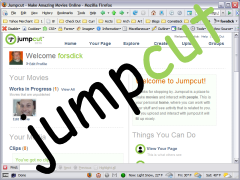
Well, it took about 1.5 months for me to come across several tools that are headed in that direction. Jumpcut is a tool that allows you to create such a compilation online out of media you have on your PC. I say "media" because you can upload video, music and still images to jumpcut.com and put the clips together with titles and transitions to produce a pretty sophisticated flash movie.

This is like having iMovie in your browser: and jumpcut does the hosting! No download of your results yet, but they have got to be thinking about how to do that. Even if they charged me a couple of bucks to download the video I created with their tools, I would gladly pay: it is certainly a lot easier than installing the tools and hosting the video myself (and I am usually against such approaches, preferring to do everything myself). Jumpcut is so easy to use, video compilations should start jumping out at us -- either from Jumpcut or any of several others in this space.

Sunday, December 03, 2006

What's the difference between PHP and Javascript?


PHP: Hypertext Preprocessor
JavaScript

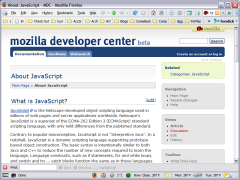
For the past 10 years, I have concentrated my programming activities in JavaScript, a scripting language in which programs run inside a client browser. Since I have been focusing primarily on what the user sees on the web, this has served me well. But there were always limitations.

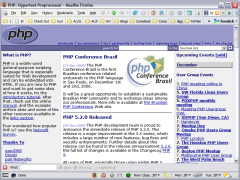
Recently, I have gotten interested in Wikis, which is a particular style of web that allows for both reading and writing. To support writing, it must have a content management system -- a system to hold the contents of a web page and which allows updating that content. I choose to focus on pmWiki because it seems to be a Wiki system which encouraged extensions -- which has turned out to be extremely useful in getting a basic mechanism to do what I want it to do. pmWiki is written in PHP, another scripting language. Unlike JavaScript, PHP scripts run on a server and can produce results (html code) that is shown in a browser.

So, why two scripting languages? Why isn't there a JavaScript that can run on a server? Why isn't there a PHP that can run on a client? For a long time, I couldn't figure out the answers to these questions. Finally, I think I have figured this out.

The differences have to do with the original purpose of the two scripting languages, and the major influences on each of them. In reality, there really isn't any difference between them -- or for that matter between them and Perl, Python and a bunch of others (see Scripting Language). The difference is due to the focus of JavaScript on running in the user's browser -- on the client side, rather than in the service provider's server -- on the server side.

If a script runs on the client side, then it must be prevented from violating the security of the user's computer: with client-side scripts, the script is downloaded from some other source -- whose motives are unknown. To prevent harm from being done, JavaScript has all sorts of restrictions placed on what can be done. One big one is, no interactions with the client computer's file system. This has such a big influence on the language that almost no one thinks of running JavaScript on the server side because it has no way to change the state of anything other than the bounded environment in which it runs. This is not because it couldn't be, but because the developers of JavaScript spent all of their creative energies working in an environment where they were just focused on activities they could perform in a web browser.

The developers of PHP focused their energies on all of the functionality you must have to be a general purpose programming language which can access all of the resources of an Internet connected computer system: they did not spend any time thinking about how to restrict PHP so that it could run client side.

And that is the difference.

I must admit that I am still somewhat surprised that someone hasn't made a bigger effort to develop a version of JavaScript that is fully competitive with PHP, Perl and the host of other server side scripting languages. There are some implementations of JavaScript that run on the server side, but they don't seem to be very popular -- PHP and Perl dominate server side scripting.