Wednesday, June 27, 2007

Craig Ferguson & Prince Charles

One of the funnier programs on TV (for me) is the Late Late Show with Craig Ferguson. Normally I wouldn't see it, but because I have a TiVo I can record the program and watch it later. Craig is Scottish and brings all of the humor of Scotland combined with the zaniness of Hollywood to the show.

It is one of those shows (like Letterman) where you have to watch it a while to get the in jokes. Having made that investment, I have spent many pleasant lunchtimes watching while I eat my lunch.

One of the skits that repeats on the show is one where Craig impersonates Prince Charles. These clips crack me up every time I watch them.


The Late Late Show with Craig Ferguson: Prince Charles

Posted Nov 14, 2005

Saturday, June 23, 2007

The Hyannis Sound

The Hyannis Sound

We went to a wonderful concert last night and I want to share this with you and hope that you get to see them this Summer on Cape Cod. The group is The Hyannis Sound, an a cappella singing group. They perform regularly 4 nights a week at 4 different locations (Falmouth, Hyannis, Chatham and Brewster) Mondays, Tuesdays, Thursdays and Fridays, through the middle of August (see their Schedule).

This group attracts men in their early 20s from college a cappella singing groups. The group has been performing on the Cape for about 15 years. Each year a couple of new members are added as vacancies happen in the 10 man group. The guys live in one house and appear to have a great time on the Cape. Tim Bongiovanni, a graduate of Lexington High School and Berklee College of Music is a member of the group this year.

Their show is very entertaining as they interleave singing with humorous stories about their lives. I was blown away by their rendition of James Taylor's "Walk Down That Road". In addition, several members of the group have really excellent solo voices, including Micah Christian who has a wonderful high, but light tenor voice, and Cooper Cerulo, the musical director this year, whose Tenor/Baritone voice was rich and mature.

All in all, a wonderful group, and a great concert for all ages and levels of appreciation for a cappella singing. Go see them!

P.S. I should also mention a brother group, The Vinyard Sound, started by the same person who started The Hyannis Sound. If you are on Martha's Vinyard, check them out. They have a similar performance schedule as Hyannis Sound. The Vinyard Sound web site and click on Schedule on the right side of the menu bar.

Saturday, June 16, 2007

Adobe - Lightroom

Adobe - Lightroom

Every once in a while I have come across a piece of software that just does the right thing with a clear interface. Intuit's Quicken is one such example. Adobe Lightroom is a new example of such an application.

If you are just getting started in digital photography, or if you haven't noticed many differences between how you take pictures in the digital world from the film world, you probably don't even know that you need an application to do the things that Lightroom does.

Lightroom helps you follow a process or workflow -- the steps you must take after you take a digital photograph until you arrive at rendering the photograph in whatever medium (print, slideshow, web) you choose to use. You may not be aware that you are doing this, and you may not currently be doing the same set of steps every time. You should. Why? Because that is the only way you can improve your technique of going from the camera to the ultimate presentation of your photos.

Lightroom helps you follow a standard set of steps you should take with every photograph you take:
  1. Off load the pictures from your camera
  2. Catalog them according to a standard naming and filing convention.
  3. Make "mechanical" improvements to a photo such as rotation and cropping
  4. Make "subjective" improvements, such as brightness, contrast, color balancing, and a whole host of other possible picture quality improvements
  5. Allow you to add labels, titles, captions, tags to photos. Allow you to examine and compare photos and form collections of selected photos.
  6. Render a photo or collection of photos in one or more ways including prints, slide shows, and web pages.
  7. And, do this all in a completely non-destructive way to the original photo that came from your camera. This is important because mistakes do happen and you never want to modify your original.
And, finally, did I mention that Lightroom is designed to works with the thousands of photos a digital photographer finds s/he has to manage. It has been built with a lot of input from professional photographers who take and process a lot of photos. You may say, well, I am not a professional, so I don't need this. But before long, you will face the same problems that professionals face and the strategies worked out in Lightroom will support you also.

For me, Lightroom has answered a set of needs I have had for quite some time.

How much does it cost? A pretty hefty $300. But wait: are you in school or do you have a child in school? If so, you can get this for $100 through the academic discount.

Thursday, June 14, 2007

Hans Rosling and GapMinder.Org

Hans Rosling: Debunking third-world myths with the best stats you've ever seen

GapMinder.Org

From TED.Org:
Hans Rosling
Even the most worldly and well-traveled among us will have their perspectives shifted by Hans Rosling. A professor of global health at Sweden’s Karolinska Institute, his current work focuses on dispelling common myths about the so-called developing world, which (he points out) is no longer worlds away from the west. In fact, most of the third world is on the same trajectory toward health and prosperity, and many countries are moving twice as fast as the west did.more ...

GapMinder.Org is a web site where Rosling makes many of the displays and tools available for viewing. It's a lot of fun to interact with the displays.

I discovered Rosling through the TED conference (see below) videos.

From the web site:
About this Talk

You've never seen data presented like this. With the drama and urgency of a sportscaster, Hans Rosling debunks myths about the so-called "developing world" using extraordinary animation software developed by his Gapminder Foundation. The Trendalyzer software (recently acquired by Google) turns complex global trends into lively animations, making decades of data pop. Asian countries, as colorful bubbles, float across the grid -- toward better national health and wealth. Animated bell curves representing national income distribution squish and flatten. In Rosling's hands, global trends -- life expectancy, child mortality, poverty rates -- become clear, intuitive and even playful.

TED: Ideas worth spreading

TED: Ideas worth spreading

My friend Joe Walters reminded me about the TED conference, and the wonderful videos of talks given at the conference that are available on the web. From the web site:

"TED stands for Technology, Entertainment, Design. It started out (in 1984) as a conference bringing together people from those three worlds. Since then its scope has become ever broader. The annual conference now brings together the world's most fascinating thinkers
and doers, who are challenged to give the talk of their lives (in 18 minutes).

This site makes the best talks and performances from TED available to the public, for free. More than 100 talks from our archive are now available, with more added each week. These videos are released under
a Creative Commons license, so they can be freely shared and reposted."

I will be posting some talks here as I watch them. They are really very impressive and worth the time spent watching them.

Sunday, May 20, 2007

River Idyll GeoCache and Charles DeGaulle Travel Bug

River Idyll GeoCache
Charles DeGaulle Travel Bug

Several years ago, I bought a Garmin eTrex Vista GPS device and started playing with it. Soon I learned about the whole world of GeoCaching: essentially playing hide and go seek where the clues are a combination of latitude/longitude coordinates and some additional hints if needed. It is a sport in the sense that it gets you out hiking to find a little boxes of trinkets (a cache) hidden in the woods. It is a two part sport in the sense that you can both look for caches as well as create and hide them.

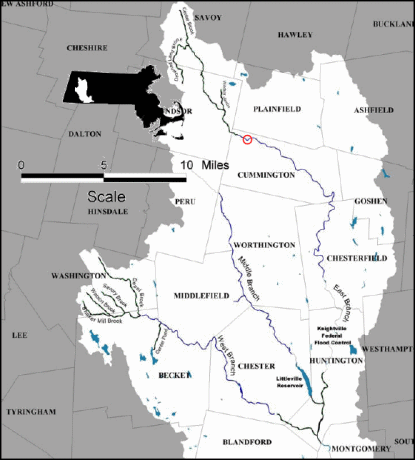
After first trying to find caches with varying degrees of success, on August 31, 2004 I created my first cache out near our summer house in the Birkshires -- a cache named River Idyll. It is situated in a lovely spot overlooking the East Branch of the Westfield River.


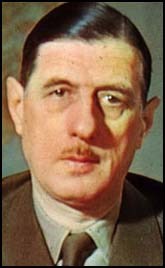
At the same time, I placed a travel bug in the cache. A travel bug is a tag attached to some artifact which has a goal. A travel bug is placed in a GeoCache. The idea is when you discover a cache with a travel bug to take the bug and advance it to its goal. My Charles DeGaulle travel bug is a picture of General DeGaulle and his mission is to make it back to Paris, France.

Well, that may be his goal, but over the last 2 3/4 years he has made a little progress, but still has a long way to go. Today I received notice that someone had retrieved my travel bug and was going to move it somewhere else. Over the period that Gen. DeGualle has been traveling back to Paris, he has already traveled
3036 miles!, but is still somewhere near Fayetteville, NC. I was very hopeful when he made it to the Atlanta Hartsville Airport, figuring that he would be taken to France by some traveler going from Atlanta to France. But, no such luck. In any case, it has been fun to watch him knock about the southeast on is random travels. Below is a map of where he has been in the last 2 3/4 years:

Saturday, May 19, 2007

TiVo Swivel Search

TiVo Swivel Search

Background

People have continually predicted that TiVo was toast as the Cable Companies began to bring out inexpensive DVRs. The theory was that although TiVo was a pioneer, like many pioneers they would be overtaken by the second wave of companies that were more nimble and cost conscious than TiVo, who would become complacent and slow to innovate a second time.

I have to admit that I actually fell for the Motorola DVR from my cable company (RCN) -- a cheap DVR for the HDTV in my. Actually at the time, I had no choice because the MOTO DVR was the only DVR that I knew of that could record HDTV. But I was sorely disappointed by the only game in town: Having been a TiVo user for years, the MOTO DVR was vastly inferior in my view. Not only was it unreliable (requiring frequent reboots) but the program listings were vastly inferior -- one of the most annoying things was that they only went out ahead four days, where as TiVo's listing went out two weeks.

After a while, TiVo came out with the Series 3 machine which was capable of recording HDTV, but it cost an arm and a leg ($800)! I was in a dilemma: Was I being too picky, was my experience with the MOTO DVR unusual? Then I read an article by Walt Mossberg in the Wall Street Journal (The HDTV Dilemma: Pay for TiVo’s Recorder Or Settle for Cable’s?) that advised people to dump their Moto HD DVRs, bite the bullet and move over to the TiVo Series 3. This was all I needed and, combined with TiVo's offer to transfer my lifetime subscription to the new machine, I ordered immediately ordered one. I haven't been disappointed!

The TiVo Series 3 is a wonderful machine: it does everything my old TiVos have done in a seamless way for both SDTV and HDTV. Very smooth.

But, now back to the concern I had heard by many pundits that low priced DVRs from vendors like Motorola would eventually overtake TiVo. You have to take these analyses seriously because they are based on experience with many comsumer products, not just TiVos. The argument was that TiVo was like Betamax -- high-end, really good, but you didn't need really good, you would be just as happy with a more universal VHS quality product.

And then I read an article by David Pogue (TiVo Plays a Trump Card: Web Smarts - New York Times) which indicated that TiVo had some cards up its sleeve that would distance itself ahead of the pack of wolves nipping at it tail. In particular, it was taking advantage of the Web to make the TiVo box be the true Living Room Media Controller. All sorts of innovations were coming to TiVos in the near future. Well, that was a long introduction to the subject of this entry...

TiVo Swivel Search

There have been several recent additions to TiVo features that I have passed up on using: I don't really have need to watch a TiVo program recorded by one TiVo on a TV connected to another TiVo -- or on my PC. Also I'm unwilling to pay Verizon to allow me to watch recordings on my TiVo on my cell phone -- I just don't find myself in places where the only way I can access TV is on a cell phone. But, there are two services (one old, one new) that I do use and these along justify using TiVo. The old one allows me to access photographs and music from a variety of sources on the internet, including my own PC. In addition, it allows me to access other sources of information (Yahoo Weather, Traffic) on the Internet - -but not a complete browser. And finally it supports a small number of games -- a capability that I like when I'm really interested in pushing in the clutch. In addition, I find that simple games on the TV in the living room (rather than on a PC in the home office) is reminiscent of the old days with parlor games: you can actually play with multiple people sitting in comfortable chairs.

But, (finally) the new feature that I really like, and think is a huge improvement, is Universal Swivel Search (wow, they must have been desperate for a unique name: I think they could have left out the in the title, and captured the entire sense of the feature). Currently TiVo searches a database of listings of upcoming TV programs. In what must have been a test, a while back they added some product review and video blog Video streams from the Web to the database. If you selected one of these, TiVo would download the video using it's internet connection.

Today, my TiVo informed me that I has just received the latest update which included Swivel Search, a generalization of the previous test capability. Now I the database is augmented with both free video on the Internet as well as paid downloads from Amazon. Just as important as being able to search this expanded database is the integration of this in with the capability of examining an existing program that you have recorded on your TiVo and ask to see related programs -- related by subject, actors, directors, etc.

For example, I had a recording where Chris Cooper was one of the stars. I asked to see more programs with Chris Cooper and I found Syriana. I'd already seen Syriana and liked it, so I asked to see more like the subject of Syriana and came across The Good Shepherd, a film I had wanted to see, but didn't. I clicked on it and discovered that I could download it from Amazon for $1 to be able to play it one time or $15 to own it. This is really a big thing because it allows me the same sense of searching the web and with a couple of button clicks to be able to download for a very reasonable price a video.

TiVo as usual is way ahead of the pack.

Nightmare web design clients

This is a great list of annoying interactions that go on between clients and web designers. Even in my limited experience, I have experienced almost all of them. In our enthusiasm and can-do attitude, I am afraid that part of the problem is that web designers/implementers have created this impression of the web. The only solution is to be willing to decline to get involved when you suspect that you will be hearing too many of these annoyances: that may be the most important skill in being a web designer/implenter.

Tuesday, May 15, 2007

Music Lifts Me Up

Music Lifts Me Up. Recently when our local State Representative held a night of favorite protest songs, I was unjustly disappointed that more of my favorites weren't played. This was clearly his show. I should get my own of I want my stuff played.

So, I am about to launch a series of entries in my blog discussing and playing my own favorites. The title of the series: Music Lifts Me Up. To see the complete collection (click on the tag below with the series name).

Monday, May 14, 2007

Fred Neil

Today's recollection is a folk singer named Fred Neil. I have no idea where I first heard Fred Neil, but his rich, deep voice, his wide variety of musical styles featuring slow ballads through loud upbeat songs accompanied by his 12-string guitar has left a lasting audio impression on me. Recently I tracked down a number of recordings that brought back great memories. I present them for your listening pleasure.


Five songs of Fred Neil (15:16)
  1. The Other Side of This Life
  2. Travelin' Shoes
  3. Gone Again
  4. A Little Bit of Rain
  5. The Water is Wide
While you are listening, here are a couple of articles about Fred Neil:And finally, here is a video with Fred Neil's The Dolphins as the soundtrack:


Monday, May 07, 2007

The Roches

Saturday night we met Alex and Kathy in Newburyport to hear The Roches. For those of you not familiar with this group, let me try to characterize them: Bell-like high voice (Terre), clear middle range voice (Suzzy) and deep low voice (Maggie) singing in the close harmony that only people who have sung together for a long time can accomplish. Combine with that a sense of values influenced by the '60s, New York City, and a good dose of zaniness, and you have my impression of the Roaches.

They have a nice MySpace page that has some good samples of how they sound (or at least sounded in their prime) Hammond Song is a great example of their close harmony and No Shoes shows off a little bit of their zaniness. Like us all, their voices have aged and the highs are harder to get to. But the values haven't changed. We had a great time.

The opening act from Ipswitch MA native Jake Armerding we a really nice surprise. I'll talk about his performance in another entry.

Wednesday, April 18, 2007

SNL Census: Christopher Walken

Here is a very funny video from Saturday Night Live: funny because Walken's answers to the census taker's questions are answers a little off topic...


Tuesday, April 17, 2007

Time Lapse Photography

YouTube - Time Lapse Video of Guy Driving Across the Country

I am about to start learning about time lapse photography. It turns out that while it used to take a lot of special purpose expensive equipment to do this, today with digital cameras and computers it is relatively easy. Now you can focus on technique rather than equipment.

Winners and Sinners

My mother used to work for the New York Times. Every once in a while, she used to bring home a newsletter published by Theodore Bernstein, managing editor of The New York Times, entitled Winners and Sinners containing examples of good writing and headlines, as well as mistakes that made it into the paper. This is an example of the type of item that would be labeled a Winner:

Headline in the New York Times on the article Seeking the Keys to Sexual Desire

Birds Do It. Bees Do It. People Seek the Keys to It

Saturday, April 14, 2007

ColorJack

  • ColorJack
  • ColorJack: Sphere (Color Theory Visualizer)


  • I love color! Here is a very interesting web site devoted to understanding color. The Sphere is a very interesting web application which can help you create sets of complementary colors.

    Tuesday, April 03, 2007

    GeoURL (2.0)

    GeoURL (2.0)
    Tell the world about your web site in terms of where you are located. Beautiful map showing registered web sites:

    Monday, April 02, 2007

    Photo Technique Newsletters

    I receive several excellent free digital photography newsletters:
    1. Photojojo
    2. Digital Photography School
    They not only cover traditional photography techniques but also talk about unique things that you can do with digital photography as well as interesting things you can do with your pictures.


    Saturday, March 31, 2007

    New Web Apps Combine Cellphones, Web & EMail

    There are more and more examples of applications that are using cellphones for input and output and web apps and email as the engine. Here are two WSJ articles describing two kinds of cellphone based apps:
    1. Friends Swap Twitters, and Frustration - WSJ.com This one is about marrying cell phone txt messaging to web micro blogs

    2. Making Voice Mail More Like Email - WSJ.com This one is about marrying cellphone voice messages to email.

    Thursday, February 15, 2007

    Yahoo! Pipes and The Web As Database


    Yahoo! Pipes and The Web As Database

    My number one interest has always been reuse of existing programs in new uses. This interest is based on my love of programming -- which, after all, is continual reuse of various snippets of patterns for doing things strung together with the connective tissue of the programming language. When I managed the development of the PINPaper (Personal Internet Newspaper) in 1995 the main premise was that there was a lot of news information available on the Internet but I was only interested in a certain focused set of topics. So, we developed special purpose programs to sift through all of this information to pick out only those articles that satisfied a keyword search for the topic.

    Last week, Yahoo announced Yahoo Pipes, a general purpose system with a nice visual interface for programming such extractions and recombinations of information on the Web. Although I haven't built anything with this system yet, I believe it is a good contribution to the activity of reuse.

    Visited Countries

    Visited Countries

    Nice, simple site that helps you generate a map of the countries in the world which you have visited. Here's mine:


    There is a companion site for US states, Visited States. Here's mine:


    Sunday, January 21, 2007

    Refugees Find Hostility and Hope on Soccer Field - New York Times

    Refugees Find Hostility and Hope on Soccer Field - New York Times

    This is a beautiful article about a team, a coach and a mother. The team is composed of refugee/immigrant boys who are bound together by their love of soccer. The coach is a tough Jordanian woman coach who teaches her team that complacency and indifference do not belong on the soccer field. The mother, Beatrice Ziaty, is a refugee from the Ivory Coast who managed to bring her children all the way to Clarkston, GA, a town that has been changed by the settlement of immigrants who now make up more than 50% of the town's population.

    If you read this article, make sure you view the multimedia slide show.

    Friday, January 19, 2007

    Deep South 2007

    Deep South 2007

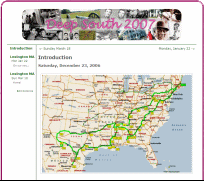
    Marsha and I are leaving on January 22 for an 8 week trip to the Deep South -- through Alabama, Mississippi, Louisiana and Texas. We'd love for you to follow along on our trip at Deep South 2007.

    Thursday, January 18, 2007

    Open House

    Open House

    Tonight Marsha, Will and I attended Jay Kaufman's Open House -- a once a month meeting he holds addressing different topics of interest to his constituents. This month the topic was The Music of Politics, the Politics of Music. The guest was Lexington resident Marilyn Beyer host of WUBM folk radio.

    Although I enjoyed the meeting, somehow I left wanting something different. I thought there was a little bit too much Folk and not enough Politics. When Jay asked for people's lists of protest songs, mine included:
    • Crosby, Stills, Nash & Young: Ohio
    • The Who: Won't Get Fooled Again
    • Bob Dylan: Masters of War
    • Bob Dylan: The Lonesome Death of Hattie Carroll
    • Bob Dylan: The Times They Are A'Changing
    • Bob Dylan: With God on Our Side
    • Phil Ochs: I Ain't Marching Anymore
    • Barry McGuire: Eve of Destruction
    • Billy Holiday: Strange Fruit
    • Marvin Gaye: What's Goin' On
    I can understand with Marylin being the guest that the selection got vectored off toward mostly Folk, but I felt that there were many important Protest songs that weren't exactly Folk and weren't represented. On the other hand, I thought Marylin's selections were comprehensive in that they went from the very old (Civil War) to very new (reaction to 9/11 written in 2006) and were probably more representative than my Vietnam Era selection.

    One of the highlights of the evening was when Lexington resident Sam Berman was identified as the first person (long before the Kingston Trio) who sang "Charlie and the MTA". After the song, Sam was asked to explain: He talked about how he and his singing group had conversation where they imagined what would happen if someone got on the subway without the extra nickel to cover the fair increase put into effect by the opponent of their candidate for Mayor of Boston. Sam's future sister-in-law wrote the lyrics and the rest is history. On a little further research, I found the following version of the story:
    Walter A. O'Brien died last month. The Boston Globe, Thursday, July 9, 1998, pp. B1 & B6 carried an appreciation of the man and his association with the song "Charlie on the MTA." The article credits the idea for the song to Sam Berman and Arnold Berman. The song itself was written by Jacqueline Steiner and Bess Lomax Hawes using the melody of "The Wreck of Old 97." Jacqueline Steiner wrote to the Globe on July 18, 1998, p. A14, with several corrections of fact in the article. She says that O'Brien's name was changed to George O'Brien when the song was recorded, because, according to his family, the recording company "did not want to make a 'hero' of a man who had been associated with the Progressive Party." The July 9 article says that O'Brien was denounced as a Communist by the Massachusetts version of the House Un-American Committee. The election song was written for the 1949 Boston Mayoral election in which James Michael Curley lost to John Hynes. In 1957 O'Brien returned to his home state of Maine and became a school-librarian and book store owner.

    Henry Scannell
    Reference Librarian
    Microtext & Newspaper Dept.
    Boston Public Library
    It was great to meet Sam in person after he and many others on the lex-polrel list have tried to keep the Progressive spirit and message alive in Lexington throughout the Bush administration. Lately it's been getting easier as Bush continues his quest to become the most inept President the US has ever had... There, I said it, and added a little more Politics to the evening.

    Sunday, January 14, 2007

    Events of 2006

    Remember the World Almanac? I used to love leafing through its pages at the various articles. One type that I've always loved are timelines: history, science -- events of all types. Well it still exists as a printed book, doing as well as it ever did, I guess. But, unfortunately they haven't figured out how to put their material online and make money off it. So, I resort to Wikipedia.

    I stumbled across an article about events in October of 2006 and loved reading the descriptive paragraph summarizing October 2006. I was hoping to capture 12 such paragraphs and put them together into a narrative for the year.
    October 2006 was a month with thirty-one days, like all Octobers, that began on a Sunday. The month was marked by a nuclear test by North Korea that prompted that passing of Resolution 1718 by the United Nations Security Council. Also at the United Nations, Ban Ki-moon was elected to succeed Kofi Annan as the secretary-general and Belgium, Indonesia, Italy and South Africa were elected to two-year terms on the Security Council; the four nations and Ban Ki-moon are expected to begin their tenures in January 2007. A fifth temporary on the Security Council was still up for grabs at the end of the month. The Nobel Prizes for the year were awarded, with Muhammad Yunus and the Grameen Bank receiving the Nobel Peace Prize. Lesotho adopted a new flag, Several national elections took place around the world during October 2006 and a scandal involving former United States Congressman Mark Foley was at the forefront just ahead of November elections in the United States. Microsoft Corporation released version 7 of its Internet Explorer internet browser software.
    Unfortunately, not all of the months have such lead off paragraphs. Instead, I direct you to the article in Wikipedia about 2006 with its links to the 12 month articles about last year.

    Monday, January 08, 2007

    Wide Angle. Telephoto and Zoom Lenses on Digital Cameras

    There is great confusion about focal lengths of lenses on digital cameras. The numbers quotes in specs for digital cameras are difficult to relate to the 35mm film camera world because if you rely on the strict measurements of focal length, then you have to take into consideration the dimensions of the digital sensor which varies from camera to camera and is almost always different than the dimensions of a 35mm film camera. Frequently you will see two numbers: one the optical zoom factor -- say 3x or 10x -- and the 35mm equivalent focal length. But to really make sure you understand your lens, you need to understand the relevant parameters that need to be considered when trying to characterize the focal length of a (zoom) lens in the digital camera world:
    1. Focal length
    2. 35mm equivalent focal length
    3. Minimum focus range
    4. Macro focus range
    5. Optical zoom
    The easiest way for people to understand the focal lengths of digital cameras with their varying sensor sizes is to use what the focal length would be if the sensor was the same as on "35mm Cameras". Of course that term isn't really accurate. It really refers to "135 film" where the image dimensions (i.e., the "sensor") is 36mm x 24mm.

    Picasso

    Here is a time lapse video of how Picasso painted a picture found by my frequent source, Richard Homonoff. I find it fascinating how Picasso really changed things as time goes on. Clearly the canvas is where he did his thinking.

    Friday, January 05, 2007

    Munich

    Munich

    We rented Munich from NetFlix and enjoyed it. Again, like the Sleeper Cell series on ShowTime, this film shows the mistakes, messy botched operations that must go on all of the time in covert operations.

    This is the story of what happened after the 1972 Munich Olympic Terrorist attack on the Israeli Olympic Team. There were 11 terrorists identified by the Mosad who had a primary role in the hostage taking. Israel wanted all 11 assassinated and this movie is the story of that operation that spanned over the next 5 years.

    This picture leaves you with a lot of questions about what went on, whether it was justified, and wondering what would happen in the future to the assassins.

    Lifehacker


    This is a very useful blog where the author gives little recipes for doing things on / for / using your computer and the Internet. This is is Tips & Tricks or How do you do ... type of site. Here is an excerpt from a Wall Street Journal article about Lifehacker and Ms. Trapani:

    Gina Trapani is always looking for a clever shortcut -- from a better way to organize her email inbox to keeping track of her Web passwords. So, it seems, are plenty of other computer users.

    Ms. Trapani, 31 years old, is the editor of the Lifehacker technology blog, which dispenses do-it-yourself advice and time-saving computing tips. Traffic to the site, one of several blogs published by Gawker Media, has surged since its launch two years ago as it has become a must-read for many computer novices and geeks alike.

    "She focuses on information that'll make her readers' lives more productive," said Robert Scoble, author of the Scobleizer blog and a former Microsoft Corp. blogger. "That's quite different from other bloggers who share gossip, give opinions or break news."

    Ms. Trapani fills her blog with tips and shortcuts -- or "life hacks" -- on addressing the kinds of problems that, increasingly, technology novices try to solve -- everything from setting up a home network to migrating from a Windows computer to a Mac. Other topics, such as how to use a cellphone to send and receive money, cater to a more savvy crowd, but contain the same sort of detailed, step-by-step instructions. Two of the most popular articles on the site have been about creating automatic hard-drive backups and transferring music from an iPod to a computer (instead of from computer to iPod).

    Ms. Trapani, who manages a staff of three writers, is something of an anomaly among bloggers. She avoids writing about herself and her posts are free of the sarcasm and snarky attitude that other blogs -- particularly those on technology -- use as calling cards. The former software programmer says she prefers to stay out of the limelight. Any publicity about herself, instead of the site, "makes me want to climb under my desk and hide," she said. "But that's just my inner geek."

    Thursday, January 04, 2007

    Sleeper Cell

    Sleeper Cell

    As those of you who know me, I am a big fan of espionage stories -- but since the fall of the Soviet Union and 9/11, there has been quite a shift in stories of that genre. I can find occasional TV series like MI-5 and I know about, but have never watched the popular Alias TV series and its excuse for looking at Jennifer Garner...

    Recently, I started viewing Sleeper Cell on ShowTime and I like it a lot. It's timely, informative and scary. Timely as in you occasionally hear about the concept of a sleeper cell in the USA -- usually from some of the more alarmist news outlets. Informative in the sense that in addition to intrigue there is a lot of background on the motivation behind terrorist attacks. Scary in that it isn't too hard to imagine something like this happening. Of course it is a bit over the top, and that is to be expected for any television drama.

    One of the things I also liked is that it is messy -- i.e., it is like real life. Not everything works out. The operations frequently fall apart as they would in real life.

    In any case, if you get a chance to view this, give it a shot.

    Dexter

    Dexter

    This was the first series I committed to watching on ShowTime. It turns out that ShowTime (owned by CBS) is a pretty good cable channel.

    When I describe this to people, they must wonder about me... Dexter is a serial killer who works for the Miami Police CSI Unit. The series tells the story in three time periods -- when Dexter was a young boy, when he was a teenager and now, when he is in his late 20's early 30's.

    When he was a young boy, his father Harry, a Miami police officer who had adopted him, recognized certain traits relating to killing animals that he understood were the precursors of the profiles of serial killers. Harry worked to instill into Dexter a code of behavior so that Dexter could channel his obsession to result in as little harm as possible.

    As a result, Dexter has become a Blood Spatter expert for the Miami CSI for his day job. In his spare time, he pursues his avocations by making sure that criminals he encounters in his day job who might otherwise escape capture and punishment do not get away... Thus the channeling his obsession to do good (for some value of good...).

    Of course he is always vulnerable to getting caught so this adds to the suspense. In addition, there are several other suspense generating mechanisms in play.

    Once you get by the blood, this is an excellent television series. There have been two seasons which you can still see and there is another season planned for the future.

    Finally, here is an interview with the author, Jeff Lindsay.

    We Are Marshall

    We Are Marshall

    I am not ashamed to say I had to wipe away the tears during this emotional, moving film. It was, in fact, a reaffirmation to me that I still had empathy for people in pain and grief. After all of the outrageous language and accusations that have gone on in the last 6 years, I sometimes wondered if the outrage had made me uncaring for others. Glad to say my sensitivity is still intact.

    In any case, back to the film. First, it is a true story: they are always better. The acting is excellent too: nothing glamorized. Matthew McConaughey is charming, unwilling to give up and unshaven. Matthew Fox is believable as the brooding assistant coach who missed the plane that crashed. And David Strathairn fits the image of a small town college president.

    This is a great picture for parents to see with their kids.

    Monday, January 01, 2007

    In Defense of Video

    Fred Astaire and Eleanor Powell: Amazing Tap Dancing

    I was going to title this first entry for the new year as "In Defense of TV", but I realized that it wasn't television that I wanted to praise, but rather the reproduction of real events by the use of video and sound.

    Frequently people cast aspersions on the amount of TV we Americans watch -- and probably justifiably so. But this video shows that the medium is fine -- and in fact sometimes superior -- its, as Marshall McLuhan said, the medium that is the significant part.

    This video clip (of the film) which was shot in one take, illustrates my point. My friend Tom Fortmann found it and let me know about it. Although possible, and perhaps that would be the artistic challenge, it would be difficult to come up with words that left me with the impression that this video engenders.

    To see more Fred Astaire videos, go here for a collection of videos assembled by my friend Richard Homonoff.

    Saturday, December 09, 2006

    More on Jumpcut

    Yesterday, I wrote about Jumpcut. This morning, I tried to see how easy it is to create and publish one of these videos on my own web site. Here is the results of about 15 minutes of work in my pajamas this morning...


    Of course the real time is taken in one of these apps when you go to improve it slightly: you can triple the time if you go for perfection...

    Friday, December 08, 2006

    Jumpcut - Make Amazing Movies Online

    Jumpcut - Make Amazing Movies Online

    A while back, I wrote the following message to friends: Hello Television Networks...? The gist of that article is that soon we will have the tools to pull together clips from all sorts of sources into compilations which approximate shows.

    Well, it took about 1.5 months for me to come across several tools that are headed in that direction. Jumpcut is a tool that allows you to create such a compilation online out of media you have on your PC. I say "media" because you can upload video, music and still images to jumpcut.com and put the clips together with titles and transitions to produce a pretty sophisticated flash movie.

    This is like having iMovie in your browser: and jumpcut does the hosting! No download of your results yet, but they have got to be thinking about how to do that. Even if they charged me a couple of bucks to download the video I created with their tools, I would gladly pay: it is certainly a lot easier than installing the tools and hosting the video myself (and I am usually against such approaches, preferring to do everything myself). Jumpcut is so easy to use, video compilations should start jumping out at us -- either from Jumpcut or any of several others in this space.

    Monday, December 04, 2006

    Digital Picture Frames

    Digital Picture Frames

    The web site above is a very nice survey article about digital picture frames.

    For quite some time, we have had a iMac in our kitchen which we use for both a computer, but also as a digital picture frame. By using the excellent Macintosh screen saver, we get a wonderful slide slow which runs when we are not using the computer. I point the screen saver at the pictures I have taken from our latest trip.

    Inspired by our kitchen display, a friend and his son built a digital picture frame out of a flat panel display and an old PC running Linux. He mounted the picture frame on the outside wall of a closet and put the computer in the closet. Unfortunately, the computer is not connected to the network and so he has to load new pictures to his frame using a CD.

    A while back, when I was trying to use gadgets to keep in contact with my aging mother, I bought a Cevia frame which was pretty cool. You subscribed to their rather expensive service and the picture frame would dial up the service each night and download pictures that you could leave for it using a web interface.

    It worked quite well, but the telephone hookup was a little annoying to rely on and the web interface was a little too difficult to use very often.

    Inspired by all of this, I have come back to the idea of building a large digital picture frame based on an inexpensive HDTV as the computer monitor and a small wireless PC which could be connected to via the web (or via FTP) for downloading photos or photo shows to be displayed. The parts and the software exist to build a 20x30" flat panel display which could show a continuous presentation of digital photos -- or any other type of presentation you could show on your computer monitor.

    All that I need to do is to take the time to build it. More on this later...

    Sunday, December 03, 2006

    What's the difference between PHP and Javascript?


    PHP: Hypertext Preprocessor
    JavaScript

    For the past 10 years, I have concentrated my programming activities in JavaScript, a scripting language in which programs run inside a client browser. Since I have been focusing primarily on what the user sees on the web, this has served me well. But there were always limitations.

    Recently, I have gotten interested in Wikis, which is a particular style of web that allows for both reading and writing. To support writing, it must have a content management system -- a system to hold the contents of a web page and which allows updating that content. I choose to focus on pmWiki because it seems to be a Wiki system which encouraged extensions -- which has turned out to be extremely useful in getting a basic mechanism to do what I want it to do. pmWiki is written in PHP, another scripting language. Unlike JavaScript, PHP scripts run on a server and can produce results (html code) that is shown in a browser.

    So, why two scripting languages? Why isn't there a JavaScript that can run on a server? Why isn't there a PHP that can run on a client? For a long time, I couldn't figure out the answers to these questions. Finally, I think I have figured this out.

    The differences have to do with the original purpose of the two scripting languages, and the major influences on each of them. In reality, there really isn't any difference between them -- or for that matter between them and Perl, Python and a bunch of others (see Scripting Language). The difference is due to the focus of JavaScript on running in the user's browser -- on the client side, rather than in the service provider's server -- on the server side.

    If a script runs on the client side, then it must be prevented from violating the security of the user's computer: with client-side scripts, the script is downloaded from some other source -- whose motives are unknown. To prevent harm from being done, JavaScript has all sorts of restrictions placed on what can be done. One big one is, no interactions with the client computer's file system. This has such a big influence on the language that almost no one thinks of running JavaScript on the server side because it has no way to change the state of anything other than the bounded environment in which it runs. This is not because it couldn't be, but because the developers of JavaScript spent all of their creative energies working in an environment where they were just focused on activities they could perform in a web browser.

    The developers of PHP focused their energies on all of the functionality you must have to be a general purpose programming language which can access all of the resources of an Internet connected computer system: they did not spend any time thinking about how to restrict PHP so that it could run client side.

    And that is the difference.

    I must admit that I am still somewhat surprised that someone hasn't made a bigger effort to develop a version of JavaScript that is fully competitive with PHP, Perl and the host of other server side scripting languages. There are some implementations of JavaScript that run on the server side, but they don't seem to be very popular -- PHP and Perl dominate server side scripting.

    Thursday, November 30, 2006

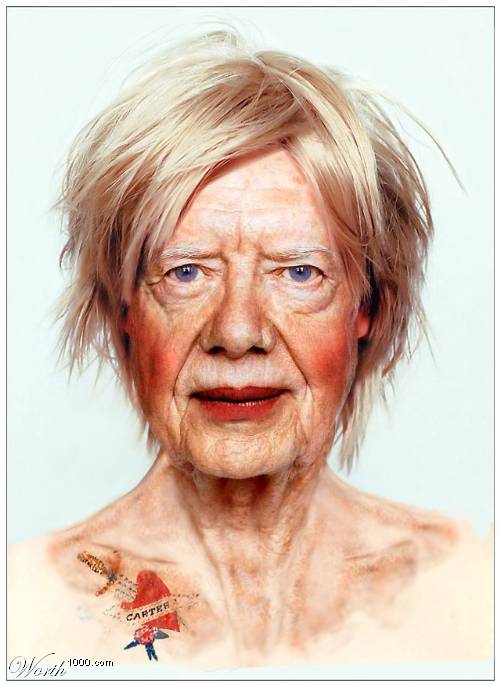
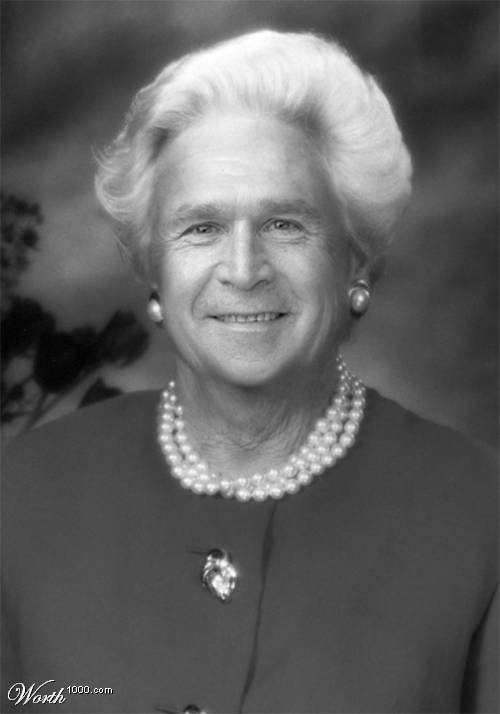
    Amazing Hacked Photos

    Worth100

    There are lots of examples of photographs that have been hacked to put the head of one person on the body of another. Usually you can tell.

    Worth100 is a web site dedicated to professional artists who can do wonders with photoshop. Today I received several images, shown below that are both comical but also a testimony what you can do in this area.